'/>

Hazel Home Art and Antiques Wausau, Wisconsin

Hazel Home Art and Antiques Wausau, Wisconsin
Showing posts with label atomic age. Show all posts

Tuesday, April 28, 2015

"If you can't convince them, confuse them". The lighting design work of Gerald Thurston for the Lightolier Corporation. 1950's and 1960's.


We have a Gerald Thurston designed lamp in stock and I had to measure it for a customer today. He was the lead designer for a company called Lightolier in the 50's and 60's. I didn't know much about him so I thought I would share what I found with you. Unfortunately there is not much biographical information out there but his design work for Lightolier is timeless and rare pieces are skyrocketing in price. Here is the one we have and it is in near mint condition. It is available for purchase here 
Beware I think they are making cheap reproductions of this lamp. They must be well made and have a solid, heavy feeling to them.


  Designer Gerald Thurston and his Million-Dollar Hand
Courtesy Global Lighting July 2013


A 1960 Gerald Thurston design, the Lightolier Lamp

A 1960 Gerald Thurston design, the Lightolier Lamp is crafted of enameled steel and plastic and measures 14×22 inches.


In 1981, I began my career in the lighting industry as an industrial designer for Lightolier. I was hired by the well-known lighting industry pioneer William F. “Bill” Blitzer (read more about him in this blog post I wrote for the Global Lighting blog in 2012). While Blitzer was an amazing mentor in the business aspect of the industry, I was fortunate enough to share an office at Lightolier with designer Gerald “Jerry” Thurston. Known for his 1950s and 60s postwar contemporary lighting designs—Thurston had a tremendous influence on me. He was extremely proud of his work and a playful man. Case in point is one of my favorite sayings I would hear him say: “If you can’t convince them, confuse them!”

Thurston’s brass-and-teak tripod design
Thurston’s brass-and-teak tripod design was a popular format and has many variations. These table lamps measure 17×24.

During the postwar construction boom and rise in mid-Century modern design, the in-house product design team at Lightolier, including Thurston, was of critical importance. Thurston’s right hand was insured for a million dollars because at the height of his career the design process consisted of drawing illustrations on craft paper—a far cry from our computer-generated graphics of today. Think about it: he was creating products at the same time Andy Warhol was making art.  I know first-hand he felt as passionate about his work as any artist ever has, even the great pop-artists like Warhol.

This Gerald Thurston table lamp has multi-colored, painted-steel shades
This table lamp with multi-colored, painted-steel shades and a brass base measures 17×17.

Today the sleek, minimalistic, and directional-light iconic lamps of designer Gerald Thurston are highly collectible and sought-after. Check out the offerings on 1stdibs.com. Gerald Thurston is a million-dollar man, indeed!

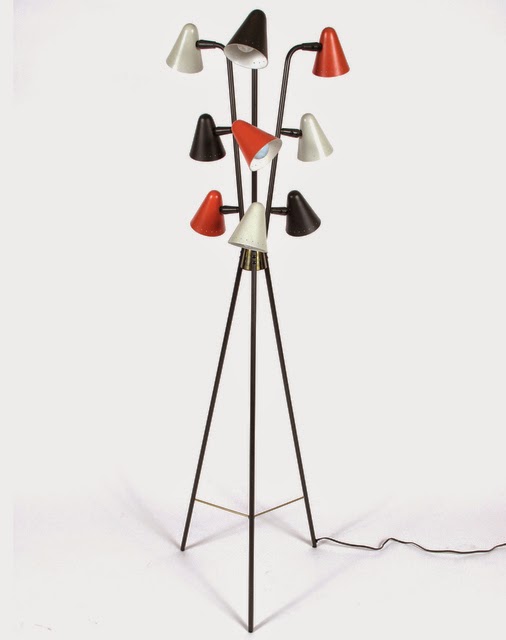
Designed in the early 1950s, the Triennale Floor Lamp by Gerald Thurston
Designed in the early 1950s, the Triennale Floor Lamp by Gerald Thurston features three perforated shades in red, white and black


 These are $5000 lamps when found in mint condition.

Monday, February 2, 2015

1965. NASA and the space race.

When I was in Mrs. Cox's class in 2nd Grade all of us were excited about the space race, astronauts, rockets, Mercury, Gemini, John Glenn and all things outer space. Walter Cronkite told us all about it every night on the television.
Actually, exploring space gave the whole country a sense of pride and accomplishment. Here is a treasury of wonderful objects from our colleagues on Etsy that speak of this time very nicely.

 Purchase here

 Purchase here

 Purchase here

Thursday, January 29, 2015

Harlequin pattern china designed by Eva Zeisel. Sugar bowl with lid, creamer and gravy boat. Made by Hall Pottery.

One of the most popular mid-century modern designers was Eva Zeisel.  Her Harlequin pattern china just screams out modernism and has that Atomic Age decoration that collectors crave.


We have three fine pieces in stock for you right now. 
These pieces are available for purchase here

Eva Zeisel

Hungary (1906-2011)

 Eva Zeisel was continually intrigued by what she called her "playful search for beauty." A person of delightfully defiant spirit, the designer was just beginning her career when she declared war on the fashionable avant-garde. "I didn't accept the purism of modern design," she said. "In my definition, if it gave beauty to the eye, it was beauty."

Zeisel was born Eva Striker in Budapest in 1906. Her father ran a textile factory and her mother was an outspoken feminist and one of the first women to earn a doctorate at the University of Budapest. It was through her mother's urging that Zeisel switched from studying painting at the Budapest Royal Academy of Fine Arts to pursue the more practical career of ceramist. She apprenticed herself to a potter at a porcelain factory, an unusual path for an educated woman at that time. Zeisel persisted, graduated to journeyman status and became the first woman admitted to the local pottery guild. It was during this time that her work took on the sensuous, flowing and biomorphic forms that would continue throughout her career.

In 1932, Zeisel moved to Russia, explaining, "It was curiosity that moved me. I wanted to see what was behind the mountain." She found a job working for the Communist government as artistic director of the glass and ceramics industries. In May 1936, everything changed. "At 4:00am, there was a knock at the door, and so began a different life," she recalled. Accused of plotting to assassinate Stalin, Zeisel was sent to prison for 16 months, 12 of which were in solitary confinement. The accusations were fabricated and Zeisel never knew who was responsible for her release or how that joyous day came to be. "I hadn't seen any colors for a year and a half," said the designer.
Upon her release, she married Hans Zeisel. They lived in Vienna briefly, before the threat of Hitler made them leave for America. "I saw the Statue of Liberty and my fears came down. It was a very touching reception," said Zeisel of her October 1938 arrival. The next day she went to the magazine China and Glass and was immediately commissioned for ten ceramic miniatures for $100. She was also hired at New York's Pratt Institute, where she became the first person to teach ceramics as industrial design for mass production, rather than handicraft. Zeisel's work continued to gather acclaim, and in 1946, her all-white modern dinner service – a first by an American designer – was honored with an exhibition at MoMA. Her work is included in the permanent collections of museums worldwide, including MoMA, the Met and the V&A. In 2005, she was awarded the National Design Award for Lifetime Achievement by the Cooper-Hewitt, National Design Museum in New York.
Courtesy of Design Within Reach


#midcenturymodern #mcm #zeisel