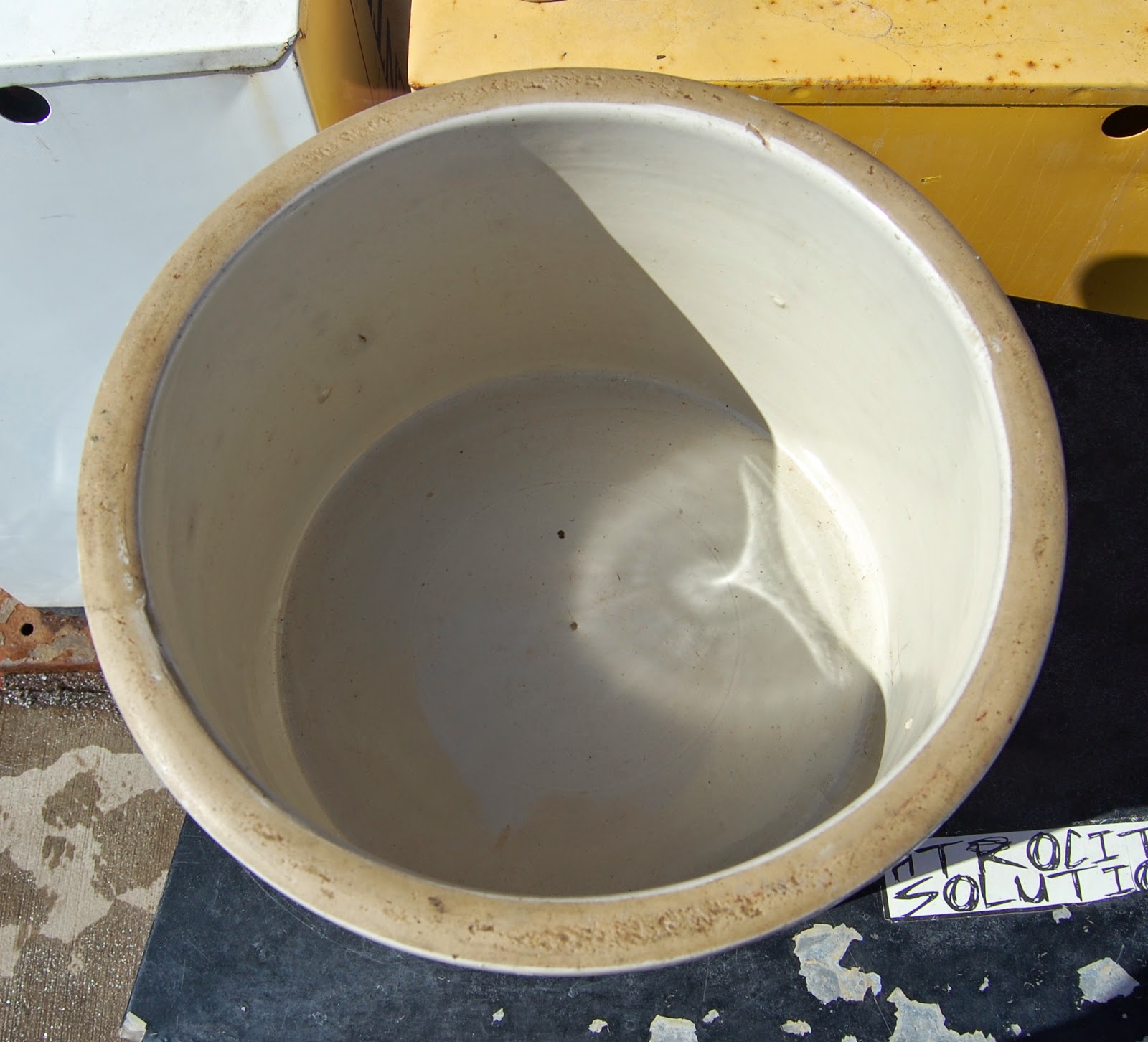
The upper Midwest is a great source for finding pottery and stoneware from the Red Wing Pottery Co. of Red Wing, Minnesota. Everyone that has been in the antique collecting hobby or the antique business has either owned or recognizes Red Wing and its distinctive mark.
The company
website shares a brief history of the company.

"Along time ago amongst the bluffs west of the Mississippi River just above Lake
Pepin, the Dakotah spent their summers hunting and fishing. French
Voyageurs first visited in 1680. Nearly 200 years later, the first
European settlers came to live beside the mighty river. They were
greeted by one of the greatest chiefs of the Dakotah Nation. He gave his
friendship to the settlers, and his name to their settlement – Red Wing
. The land around Red Wing was rich with clay. In 1861 a German
immigrant named John Paul discovered a rich pocket of clay on the land
that he intended to farm. A potter by trade, he used this clay to make
the first Red Wing stoneware.
After Paul came Philleo Pottery, established in the heart of Red Wing in 1868, followed by Hallem Pottery
. Both
went out of business – the former destroyed by fire, the latter by the
drastic price cutting of established eastern competitors. It was in 1877
that the Redwing Stoneware Company
forerunner of today’s famous Red Wing Stoneware and Pottery was established.

The company supplied farmers with stoneware crocks and jugs for food
and beverage storage. As our young country grew and the Industrial
Revolution took people off the farms and brought them together in towns
and cities, health concerns prompted the development of sewer systems.
The Red Wing Sewer Pipe Company met the great need for ceramic sewer pipes. Two other companies were formed just before the turn of the century, Northstar Stoneware and Minnesota Stoneware
. By 1906 one company had gone out of business and the other three companies combined as the Redwing Union Stoneware Company.

With changing times, and especially the invention of the
refrigerator, the old stoneware crocks and jugs were no longer needed.
In 1913 the first refrigerators were invented for home use, although the
cost was out of the reach of most people (one 1922 refrigerator cost
$714, compared to $450 for a Model-T Ford).
At this point, Red Wing Union Stoneware Company began
producing flower pots and vases, then luncheon and dinnerware, and a
wide variety of art pottery. In 1936 the name was changed to Redwing Potteries."
Another interesting written history is furnished by
Pottery Place Antiques. They also furnished the historic photographs used in this post.
 "Red Wing Pottery
has a rich place in Minnesota history. The first known potter in the
area came to Red Wing in 1861 and settled on what later became the Red
Wing clay pits. John Paul, a German potter, produced pottery from his
wheel for 10 years. In 1871, he moved to Shakopee and became a brick
mason. Red Wing Terra Cotta Works, under Wm. M. Philleo began producing
pottery and architectural terra cotta during the 1860's. Red Wing
Stoneware Company sprung up in 1877 and quickly earned a name
for producing quality stoneware. Later, Minnesota Stoneware Company
appeared on the scene in Red Wing in 1883 and in 1892 North Star
Stoneware Company began. Each of these companies were built using the
latest technology and were soon able to mass produce the stoneware.
However, the 1890's brought a severe economic down swing and left each
of the three companies having to periodically shut down and cut down.
In 1894, Union Stoneware Company was born as the sales outlet for all
three companies. Northstar Stoneware Company, being the newest and
least known, could not compete and ended up shutting its doors in 1896.
By 1900, prosperity had returned and by 1906 Red Wing Stoneware,
Minnesota Stoneware, and Union Stoneware Company merged to become the
Red Wing Union Stoneware Company.
"Red Wing Pottery
has a rich place in Minnesota history. The first known potter in the
area came to Red Wing in 1861 and settled on what later became the Red
Wing clay pits. John Paul, a German potter, produced pottery from his
wheel for 10 years. In 1871, he moved to Shakopee and became a brick
mason. Red Wing Terra Cotta Works, under Wm. M. Philleo began producing
pottery and architectural terra cotta during the 1860's. Red Wing
Stoneware Company sprung up in 1877 and quickly earned a name
for producing quality stoneware. Later, Minnesota Stoneware Company
appeared on the scene in Red Wing in 1883 and in 1892 North Star
Stoneware Company began. Each of these companies were built using the
latest technology and were soon able to mass produce the stoneware.
However, the 1890's brought a severe economic down swing and left each
of the three companies having to periodically shut down and cut down.
In 1894, Union Stoneware Company was born as the sales outlet for all
three companies. Northstar Stoneware Company, being the newest and
least known, could not compete and ended up shutting its doors in 1896.
By 1900, prosperity had returned and by 1906 Red Wing Stoneware,
Minnesota Stoneware, and Union Stoneware Company merged to become the
Red Wing Union Stoneware Company.

The processes for making the pottery changed as the
industrial revolution provided more and more opportunities for
mechinization. Hand turning was totally abandoned by 1917 and all but
jug handles were molded or pressed by machine. Red Wing Stoneware
became the leading producer of stoneware in the world. However, the
industry would change in the next few decades for several reasons.
First, the rich clay fields needed for the stoneware were limited, and
secondly, with the development of refrigeration and plastic food
containers, the need for stoneware would diminish and disappear. The
company positioned itself to make way for these changes; kitchenware
and art pottery began to be produced which could be made from other
clay. By 1936, the focus was more on the art pottery and the beginnings
of producing dinnerware; thus the name changed to Red Wing Potteries
Inc. By the end of WWII, the stoneware industry had died. Red Wing
Potteries then began designing many more dinnerware patterns and various
lines of art pottery.
These products became very popular and the company flourished.
However, by the 1960's, foreign competition and changing tastes were
creating a down turn in the Red Wing pottery business. In 1967, after a
brief workers' strike, the company closed its doors forever".
The photos of examples of Red Wing are courtesy of
The Red Wing Collectors Society.
An area of Red Wing collecting that is really hot right now is of advertising crocks. These held butter and were made and marked for the individual dairy or store. Prices are going through the roof.
Procks Crocks and Antiques has some great examples.
Hazel Home Art and Antiques sold a pretty rare piece of Red Wing in 2014. This is a small toothpick or match holder with a gopher climbing on an old stump. Remember, Minnesota is the home of the Golden Gophers. This piece was made for the RTDA of St. Paul in 1938. I believe it was a Polish benevolent association that was connected to a Lutheran or Catholic church. Anyway, this piece was well-marked and had a few rub-throughs on the brown glaze but a collector snapped it up pretty quickly.

 This past week I stumbled across a very rare and interesting piece of Winter Carnival memorabilia. A pendant from the 1887 Carnival. This was the second year of the event that exists to this day. This little piece is only 9/16" square. It retains it's original loop and is in fine coin like quality. The front features the Ice Palace and the words "St. Paul Ice Palace and Winter Carnival" and the date 1887. The back has a fantastic pair of snowshoes, a toboggan and a torch. This is an early photo of the Palace. Here are the front and back of the pendant we are offering for sale here

 In 1885, a New York reporter wrote that Saint Paul was, "another Siberia,
unfit for human habitation" in winter. Offended by this attack on their
city, the Saint Paul Chamber of Commerce decided to prove not only that
Saint Paul was habitable but that its citizens were very much alive
during winter, their most dominant season. Thus was born the Saint Paul Winter Carnival.
The first carnivals were held in 1886, '87, '88 and 1896. They were
revived in 1916 and 1917. Beginning again in 1937, they continued
through 1942, resuming on a permanent basis in 1946.
In 1885, a New York reporter wrote that Saint Paul was, "another Siberia,
unfit for human habitation" in winter. Offended by this attack on their
city, the Saint Paul Chamber of Commerce decided to prove not only that
Saint Paul was habitable but that its citizens were very much alive
during winter, their most dominant season. Thus was born the Saint Paul Winter Carnival.
The first carnivals were held in 1886, '87, '88 and 1896. They were
revived in 1916 and 1917. Beginning again in 1937, they continued
through 1942, resuming on a permanent basis in 1946.
 The event featured many activities including bobsledding and ice
horse-racing. The former name uniquely and directly describes the
activity as frozen lakes were used as race surfaces for sled-carts. The
events also served to bring the community closer together including
members of nearby Native American tribes. Many members of local tribes would ride into the city and pitch tents to participate in the Winter Carnival.
The event featured many activities including bobsledding and ice
horse-racing. The former name uniquely and directly describes the
activity as frozen lakes were used as race surfaces for sled-carts. The
events also served to bring the community closer together including
members of nearby Native American tribes. Many members of local tribes would ride into the city and pitch tents to participate in the Winter Carnival. The Winter Carnival has grown over the years and the legend has
evolved to place it in the role of a strong community organization. The
Royal Family makes over 400 appearances in a given year and participates
in many activities to benefit the communities around the Twin Cities Metro Area.
As a community organization, the members of the Royal Family and Vulcan
Krewe travel internationally throughout the US and Canada visiting
different communities and engaging in various festivals. They promote
community awareness and volunteerism and support many causes. For info on the current carnival click here
The Winter Carnival has grown over the years and the legend has
evolved to place it in the role of a strong community organization. The
Royal Family makes over 400 appearances in a given year and participates
in many activities to benefit the communities around the Twin Cities Metro Area.
As a community organization, the members of the Royal Family and Vulcan
Krewe travel internationally throughout the US and Canada visiting
different communities and engaging in various festivals. They promote
community awareness and volunteerism and support many causes. For info on the current carnival click here The Winter Carnival is held during January each year. It was not held
during World War II out of respect for the conflict abroad. Currently
the Winter Carnival runs the following events as part of the
celebration:
The Winter Carnival is held during January each year. It was not held
during World War II out of respect for the conflict abroad. Currently
the Winter Carnival runs the following events as part of the
celebration: