'/>

Hazel Home Art and Antiques Wausau, Wisconsin

Hazel Home Art and Antiques Wausau, Wisconsin
Showing posts with label new york school. Show all posts

Friday, September 11, 2015

From the New York Times: John Perreault, Art Critic (and Artist) Who Championed the New, Dies at 78

John Perreault, Art Critic (and Artist) Who Championed the New, Dies at 78


John Perreault reviewing a de Kooning show for The Village Voice. Credit Fred W. McDarrah/The Village Voice
John Perreault, an art critic at The Village Voice and The SoHo Weekly News who was an early champion of feminist art and the craft-oriented pattern and decoration movement in the 1970s, and who later held senior curatorial positions at the Snug Harbor Cultural Center on Staten Island and the American Craft Museum, died on Sunday in Manhattan. He was 78.
The cause was complications of gastrointestinal surgery, his husband, Jeff Weinstein, said.
Mr. Perreault started out as a poet and painter, but after being recommended by the poet and art critic John Ashbery, he began writing criticism for Art News. In 1966, The Village Voice made him its chief art critic, and he used the position to make the case for new art and work outside the mainstream, especially the creations of feminists like Judy Chicago; photorealism; art with gay content; and the pattern and decoration art associated with the Holly Solomon Gallery.
On Artopia, a blog on the website Arts Journal that he started in 2004, he described his interests as ranging “from Minimalism and Earth Art to realist painting; from pattern painting to performance art; from street works to ceramics and design.”
Mr. Perreault’s reviews were required reading for anyone trying to make sense of the swirling, often confusing, art scene of the 1970s, when movements and trends vied for attention.
As an artist himself, he became friends with many of the subjects he wrote about.
Alice Neel painted him, nude, in a portrait shown at her 1974 retrospective at the Whitney Museum of American Art. In “The Turkish Bath,” Sylvia Sleigh painted him — nude again — with his fellow critics Lawrence Alloway and Carter Ratcliff. Depicted from the chest up, this time wearing a shirt, he was the subject of a 1975 portrait by Philip Pearlstein.
John Lucas Perreault (pronounced per-ALT) was born on Aug. 26, 1937, in Manhattan and grew up in Belmar, N.J., and other towns along the Jersey Shore. His French Canadian father, Jean, parlayed his experience cooking on merchant marine ships during the war into a series of restaurant jobs.
In high school, John scooped ice cream at a Howard Johnson’s along the Garden State Parkway where his father worked. There he mastered the profit-pumping technique of creating a curled scoop that looked like solid ice cream from the outside but actually contained a large air pocket.
After studying briefly at Montclair State Teachers College (now Montclair State University), he enrolled in Kenneth Koch’s poetry workshop at the New School for Social Research in Manhattan. His first poetry collection, “Camouflage,” was published by Lines Books in 1966, with an introduction by Mr. Ashbery. He was also the author of the collections “Luck” (1969) and “Harry” (1974).
In the mid-1960s Mr. Perreault began exhibiting his paintings at One Eleven Gallery in Greenwich Village. He soon turned to conceptual and performance art. For the Poetry Project at St. Mark’s Church-in-the Bowery, he recited a long poem, “Hunger,” as color slides were projected on his back. He also did a series of street projects with Vito Acconci and, with Hannah Weiner and Eduardo Costa, organized the Fashion Show Poetry Event, which featured clothing made by Andy Warhol, Claes Oldenburg, Alex Katz and other artists.

After The SoHo News, as it had been renamed, went out of business in 1982, Mr. Perreault became the chief curator of the Everson Museum of Art in Syracuse. He was the director and curator of the Newhouse Center for Contemporary Art at Snug Harbor from 1985 to 1989, a period when, the critic Vivien Raynor wrote in The New York Times in 1995, “the Staten Island art scene experienced a kind of golden age.”
He was a pivotal figure in organizing the first “Day Without Art” in 1989 to draw attention to the impact of AIDS on the arts. More than 600 cultural institutions took part in what became an annual event.
After serving as senior curator at the American Craft Museum (now the Museum of Arts and Design) from 1990 to 1993, he became the artistic director, and later executive director, of Urban Glass, a workshop and gallery in Brooklyn, and the editor of its magazine, Glass Quarterly.
Mr. Perreault taught at several schools, including the New School, the School of Visual Arts in Manhattan, the University of Arizona in Tucson and the State University of New York at Binghamton. It was while teaching at the University of California, San Diego, that he met Mr. Weinstein. They married in 2008 in Massachusetts. He is also survived by a brother, Ron, and a sister, Barbara Kaska.
Mr. Perreault was the author of numerous catalogs and books, including “Philip Pearlstein: Drawings and Watercolors” (1988). His fiction was collected in “Hotel Death and Other Tales,” published in 1989.
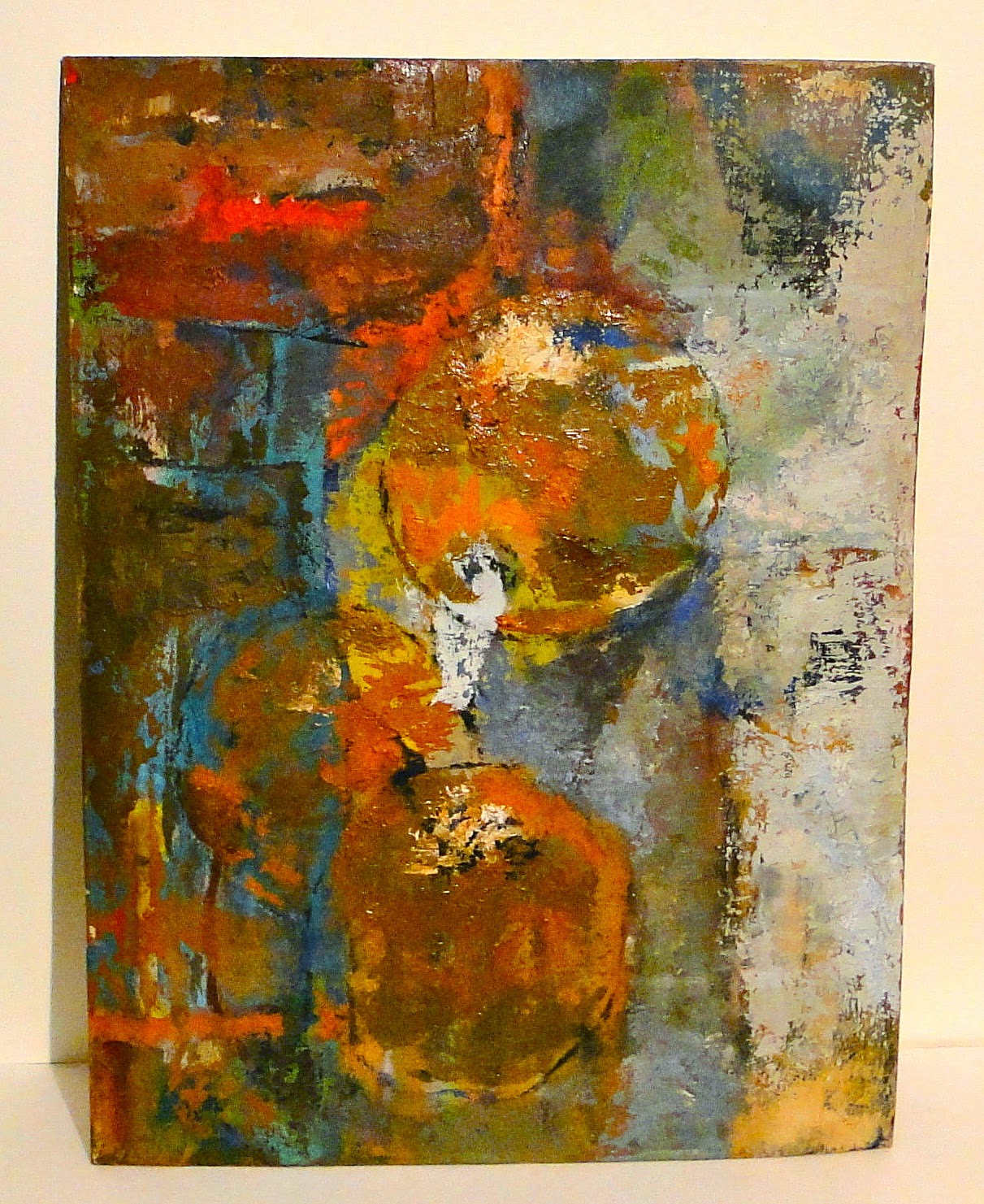
In recent years Mr. Perreault began painting again, exhibiting at Gallery 125 in Bellport, N.Y., on Long Island, where he had a second home. He turned to unusual media, including toothpaste, sand and instant coffee, a nod to Bellport’s status as the summer home of the man who first mass-produced instant coffee.
“Although my guess is that the art ‘object’ is done with, I myself still go on making ‘paintings,’ but this doesn’t have much to do with making salable physical objects,” he told the magazine Art Experience NYC in 2011. “Making them is more like philosophical investigations, art criticism or yoga.”

Friday, May 22, 2015

The figurative paintings of John Barnes Dobbs (1931-2011)

This morning I was flipping through a Slotin Folk Art Auction from 2014 and ran across a painter I wasn't familiar with, John Dobbs. His style is very much Northern California figurative but it turns out he was a New Yorker through and through. Whats interesting is he maintained his love of figurative painting in the 40's and 50's while the winds of "abstract expressionism" were blowing all around him. I can only imagine how he was viewed by the "modernists". He must have dealt with it much as Fairfield Porter did, he stayed true to himself and just kept working. Here is an excellent obituary from the Examiner.

"John Barnes Dobbs, a determinedly figurative painter who launched his career in the 1950s against the prevailing winds of Abstract Expressionism, lived to see a time when Realism would coexist with Abstraction, Minimalism, Conceptual Art and a variety of other artistic movements. On August 9 Dobbs died at his home in New York’s Greenwich Village at the age of 80.
During a career that spanned more than half a century, Dobbs painted his own dusky vision of humanity: figures embedded—more often than not—in an alienating, modern landscape of city and suburb. The people on his canvases are often seen in the distance or from behind, as if departing. They ride up escalators, wait on subway platforms or pass through turnstiles. We glimpse their silhouettes through plate glass windows or in the glare of sun on concrete.
In his final works, Dobbs’ figures appear against flat backgrounds, iconic as the images on tarot cards: acrobats, boxers and contortionists, struggling against the physics of their own bodies and that of the universe.


Dobbs had many solo shows at galleries, universities and museums. His work was exhibited at the Museum of Modern Art, the Whitney Museum, the American Academy of Arts and Letters, the Butler Institute of American Art in Ohio, and the Salon Populiste in Paris. Dobbs’ paintings are part of the permanent collections of the Hirshhorn Museum, Washington, DC; the Montclair Art Museum, Montclair, NJ; the Neuberger Museum, Purchase, NY; the Canton Museum of Art, Canton, OH and the Springfield Museum of Art, Springfield, MA.
From 1972 to 1996, he was a Professor of Art at John Jay College, City University of New York. He was a member of the National Academy, to which he was elected in 1976.

Born in 1931 in a small house by the Lackawanna Railroad in Nutley, New Jersey, where his grandfather had once worked as a railway express clerk, Dobbs grew up in a politically engaged family of artists, musicians and poets. Yet he credited the shining rails that ran past their little house with giving him his first lesson in one-point perspective. Although he studied with several painters during his twenties, he always referred to himself as a “self-taught” artist.
At 18, after graduating from high school, Dobbs hoisted a duffle bag onto his shoulder and hitchhiked cross-country. He worked at a variety of odd jobs before returning to the East Coast to study painting with Ben Shahn, Gregorio Prestopino and Jack Levine, who became his mentor and life-long friend.
In 1952 Dobbs was drafted into the Army and stationed in Germany. He brought along a sketchbook, which he filled with drawings of soldiers and post-war German life, later published in a chapbook, “Drawings of a Draftee” (1955).
After returning to the United States, Dobbs married French-Algerian literary scholar Anne Baudement and had his first one-man show at the Grippi Gallery in New York in 1959. Four years later, painter Raphael Soyer included Dobbs—along with Edward Hopper, Leonard Baskin, Jack Levine and eight other figurative artists—in his large group portrait, Homage to Thomas Eakins.
Soyer’s canvas was a cri de coeur for 20th century American Realist painting. But, although he and Dobbs became close friends and artistic compatriots, their work developed along different directions. While Soyer devoted himself to painting from life, Dobbs worked from memory and imagination, employing both literal and symbolic imagery to invoke America’s collective preoccupations and dreams.
Those dreams, as Dobbs conceived them, can sometimes be terrifying. In Deodand #2, (1969), painted by Dobbs during the height of the protests against the war in Vietnam, a large revolver points straight at the viewer. Staring down the barrel of the gun is the shadowy face of a helmeted policeman. With its oversized revolver, gripped in huge hands, the work confronts us more directly and aggressively than news footage ever could. The artist is willing to let us squirm before this hyper-realistic nightmare of the American history from which we are still trying to awake.
“I’m not afraid to say I’ve made paintings that can be hard to live with,” Dobbs wrote near the end of his life, responding to often-heard comments that his work is both beautiful and disturbing.
Certainly we can trace Dobbs’ artistic lineage from Goya through George Grosz, those break-and-enter artists who brought fury into the drawing room and have never been entirely forgiven. As with those earlier, socially conscious painters, one senses that the demons that pursued Dobbs were as much personal as political. That’s one reason the sloppy labels “Realist” and “Social Realist” that have dogged him and his circle for decades don’t shed much light on the paintings.
In the unforgettable self-portrait White Mask (1999), Dobbs’ haunting gray eyes stare out of his long, bearded face. They are cool, appraising and unflinching. But instead of a cap on top of his balding head, the artist wears an African totem. It’s a large wooden mask, painted white, the color of death. And its coal-black eyes stare off into an otherworldly, steel-blue distance.
“I am your doppelgänger,” the ghostly second head seems to say, “and I come from a world that’s truer, deeper and more real.”
Dobbs is survived by his wife Anne, sons Michel and Nicolas, and his sister Louise DeCormier and her family. His work is represented by ACA Galleries in New York and George Krevsky Gallery in San Francisco".

All works here are courtesy of the artists website and Krevsky Gallery.

Click below to see more of Dobbs work and read a brief autobiographical piece that appeared in The Last Bohemians.

Wednesday, January 21, 2015

"with love to the everyday miracle" by Sister Corita Kent American 1918-1986

The artist that truly reflected the 1960's mantra of "make love, not war" definitely was Sister Corita Kent.  Not only did she carry this message in her art she lived it throughout her life of devotion and spiritualism

Recently Google used her as their artist of the day and so people are re-interested in this fascinating woman.  The most complete bio and evaluation of Sister's work can be found here Please check it out it is really wonderful.
  Corita Kent (November 20, 1918 – September 18, 1986), aka Sister Mary Corita Kent, was born Frances Elizabeth Kent in Fort Dodge, Iowa. Kent was an artist and an educator who worked in Los Angeles and Boston. She worked almost exclusively with silkscreen and serigraphy, helping to establish it as a fine art medium. Her artwork, with its messages of love and peace, was particularly popular during the social upheavals of the 1960s and 1970s. Kent designed the 1985 United States Postal Service annual "love" stamp. http://en.wikipedia.org/wiki/Corita_Kent https://www.corita.org/ #popart #art #sistercorita


Over 700 million copies of her 1985 LOVE stamp for the U.S Postal Service were printed.


We are selling an original, signed serigraph, from 1967. Image size is 23" x 35", original 1970 framing company stamp verso. Newspaper review of a documentary called "Primary Colors: The Story of Corita" verso. Non-reflective glass.  It is available here

 
Quote text: Conversion is revolution is growth is living in a way appropriate to the coming age and is not understood by the present age which is passing away God descends man ascends and they move on For you WITH LOVE TO the everyday miracle that's me! that's my color!

Sunday, January 11, 2015

Rick Hall American (1964-2012)

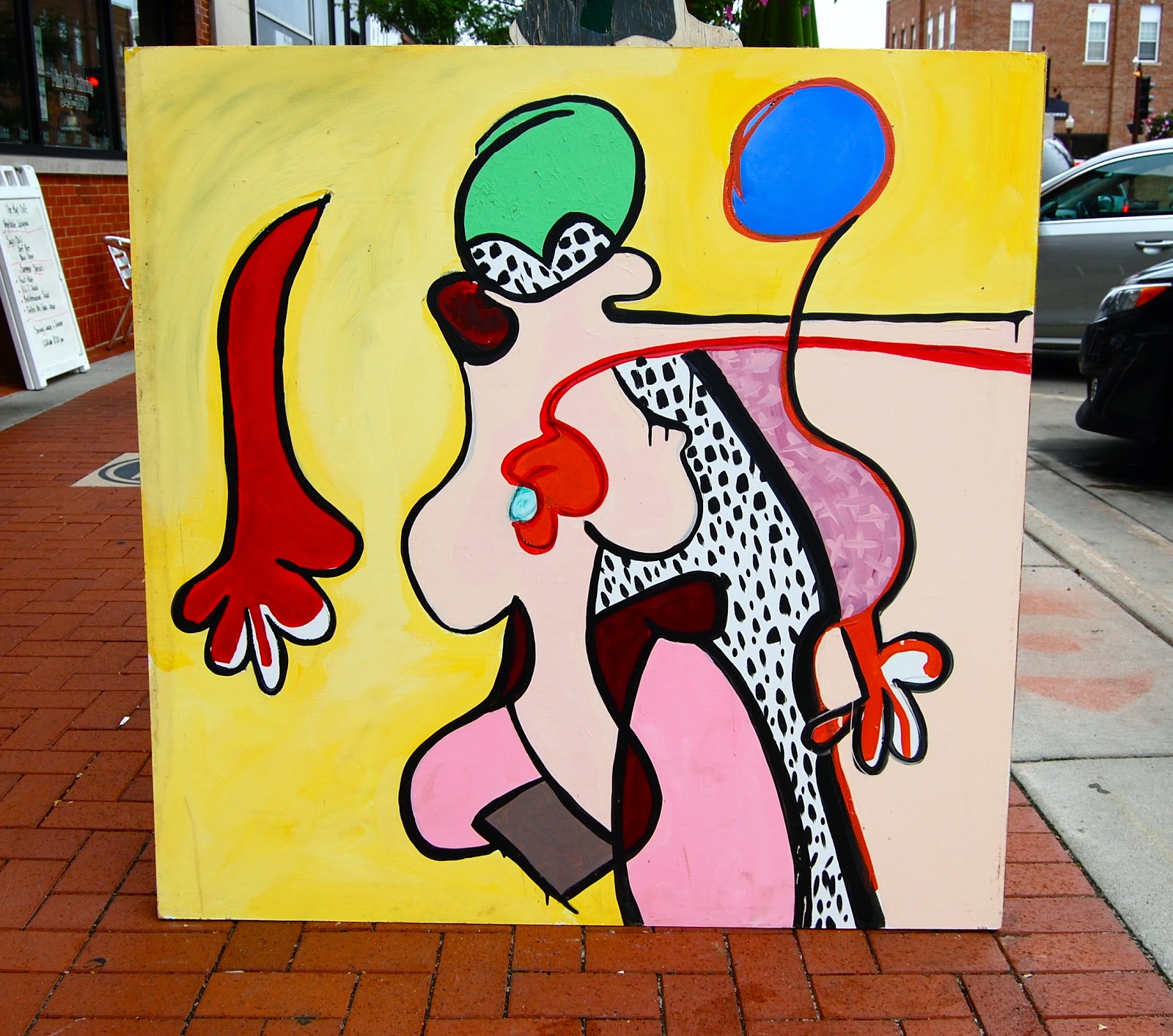
One of the highlights of 2014 was the acquisition of the estate paintings of Wausau, Wisconsin Rick Hall. These works had been unseen since 1992. Rick was influenced strongly by the New York School, modernism, Jean-Michel Basquiat, Keith Haring and of course Picasso.

Rick was self-taught but vigilant in improving his craft. His daughter confirmed that many nights she never saw him as he went to the basement to paint everyday after work. The results speak for themselves. These paintings are vivid, bold, full of energy and color. Please enjoy looking.

All paintings are 48" x 48" acrylic and oil on 1/4" masonite and share varying degrees of moisture damage about 1"-2" up on the bottom. Structurally sound but stained.

 Available here.

 Available here

 SOLD.

 Available here

 Available here
 Available here
 Available here

 Available here

 Available here